
Return to Tenth Meridian Systems

The walkthrough

Inside the Establishment

See how Tenth Meridian delegates work, sets budgets, applies safety gates, and keeps receipts across the operating loop. The film labels what is in operation, what exists as a reference implementation, and what remains a concept or roadmap capability.

Narrated by Alexandra23 min 27 secSeven chapters
A contact sheet showing the chapters and operating systems inside the Tenth Meridian walkthrough
The revised master will enter this player after review.

The chapter map

The film follows the operating loop.

The walkthrough is long because it follows the operating loop instead of cutting straight to the result. Use the chapters to enter where the question becomes useful.

The claim follows the label.

Read the labels before you read the claims.

Some scenes show the systems already running inside Tenth Meridian. Others are reference implementations, concept simulations, or roadmap capabilities. The label on each scene tells you which one you are looking at.

In operation

The system is part of Tenth Meridian's current operating environment.

In operation internally

This system runs inside Tenth Meridian today.

Reference implementation

This is a built implementation used as a reference. It is not presented as client work.

Concept simulation

This is a hypothetical operating case designed to show how the system could behave.

Roadmap capability

This capability is modeled or planned. It is not shipped.

Meet the offices, the delegation loop, and the publishing desk

In operation internally

Full site redesign and client reporting

Reference implementation

Bloom & Wick, Meridian Freight, SÉRAC, Northbeam Support, and Tenth Meridian Press

Concept simulation

The cockpit and the managed agent team

Roadmap capability

The pricing figures shown inside the film

Illustrative, scope dependent

Contractor participation

Scoped per engagement

The SÉRAC phone escalation and the dedicated client crew are modeled capabilities. They are not shipped communication paths. The prices shown in the film are illustrative starting points, not a public rate card.

The narration transcript

Alexandra's narration

This transcript follows the approved narration. Agent and phone dialogue remains inside the film.

Ask about the operating model
01Introducing Tenth Meridian

Introducing Tenth Meridian. A company built for one thing... making good decisions when the world gets messy, and uncertain, and fast. That is the real product. It began in quantitative trading, because quant keeps you honest — you write down what you believe, the market tests it with real money... and there's nowhere to hide from the result.

Underneath it sit six arms, and they feed each other. The fund is the proof engine, where ideas get pressure-tested. Systems is the plumbing. The institute researches, the observatory watches the world, the press publishes what the company learns... and the governance core keeps everyone honest. What you're about to see is the machine all six of them share — a company that runs on agents. And everything it does here... it can do for your business too.

02The engine enters

Every company has an origin, and this one is honest. It began with one person who had way more ideas than hands to build them... and no patience for typing every line of code. What he was good at was seeing how a system should work before it existed... and making sure whatever got built didn't fall apart the first time reality touched it. So instead of hiring a department... he built one. A company you could run... just by talking to it.

03The system

Here's how it actually works. At the top is Viorve, the chief of staff — and that's literal. You hand her a request the way you'd hand it to a person... she works out what it needs, sets a budget, puts the safety gates around it, and hands it to the right office. Underneath her sits Aurelius, the runtime. It does the work... and it keeps the receipts on every single call. And here's the part worth being proud of... none of this was rented from a no-code tool. The orchestration layer was built from the runtime up — the routing, the budgets, the gates, the receipts, and the loops that run overnight... all of it owned, not borrowed. The models come from Claude and OpenRouter, the tools arrive over MCP... but the machine that runs them belongs to the company.

04Meet the offices

So let me introduce the people who run it. You already know Viorve, because everything goes through her. Dexter runs the quant lab. And behind those two... there's a whole building.

Every card you're looking at is a department, not a single bot. The quant lab alone has researchers, a risk quant, a validation quant, and its own red team... whose entire job is breaking things before the market does. Then there's the writers' office, the design studio, security, growth, budget, and cloud ops. thirteen offices, about seventy specialists... and when a project lands, it gets staffed by the office that owns that kind of work.

It was built this way so that no one person is ever the bottleneck again. Watch them work... and you'll see what that means.

05Contractors

One more thing before the demos, because people always ask. The company brings in contractors too — Claude Code and Codex, open and ready. When there's something heavy to build, they reach in, they sit in the same thread as the agents, and they work shoulder to shoulder with them. And each one gets named for the project it's on, so you always know who's who. Claude Quant Contractor lives in the fund, Codex Portfolio Contractor runs the portfolio work. Any subscription agent can plug in the same way... and Viorve just tells them where to sit.

06The delegation loop

Here's what actually happens when the boss wants something. No dashboard, no ticket. He just messages Viorve... the same way you'd message a person.

And that's the whole loop. She confirmed what he actually meant, briefed the right office with real context, and came back with a receipt he can audit. About thirty seconds of attention... and it happens every single morning, whether anyone's awake or not.

07My draft, their desk

Now the writing, because this part matters. He writes every article himself. That's never left his desk... because the voice is the whole point. What left his desk is everything that happens after the writing.

So he stayed the writer... and they became the desk around him. And notice what they did — nobody rewrote him. They checked him. That's the difference between an AI that replaces your voice... and a system that protects it.

08Full site redesign

And this is the fun one, because it's the biggest thing he's handed them. He asked them to redesign his entire website. And I mean the real one — the site that's live right now.

That was a week of work end to end, across five offices and a contractor swarm... and his total contribution after the brief was one joke in the group chat. That's the job now. That's the whole job.

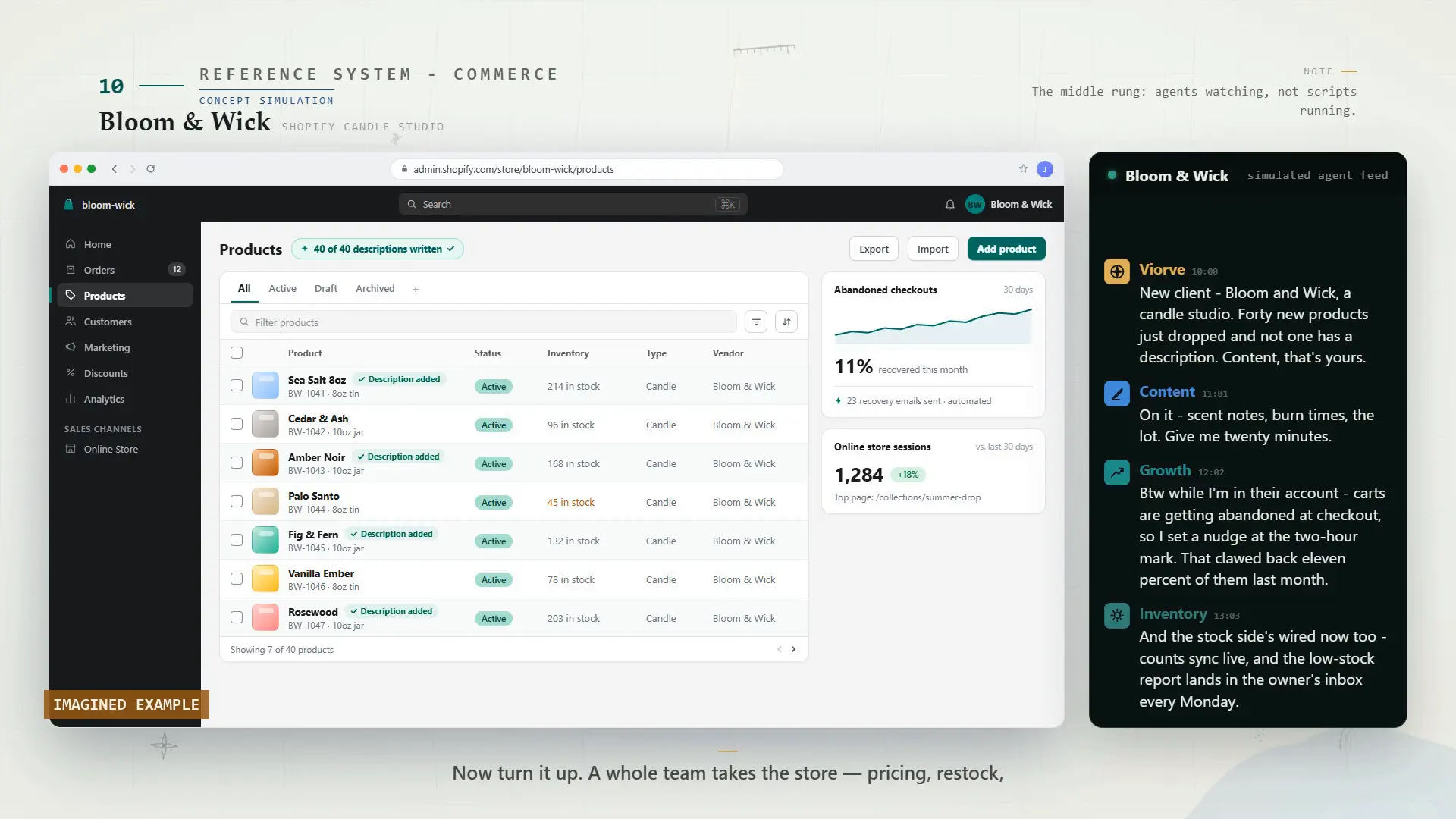
09Bloom & Wick

So that's the company itself. Now watch the same machine point at your business, walking up the ladder... from simple, to honestly, kind of ridiculous. Say you run a Shopify store.

At the simplest end, an agent just watches your store. A new order comes in, it syncs the inventory, drafts the reply, flags anything strange. Nothing fancy... it just never sleeps.

Now turn it up. A whole team takes the store — pricing, restock, the reviews, the abandoned carts, the ad copy — all talking to each other, all leaving receipts. That's not one automation anymore... that's a department you didn't have to hire.

Same machine, same receipts... just pointed at candles instead of currencies.

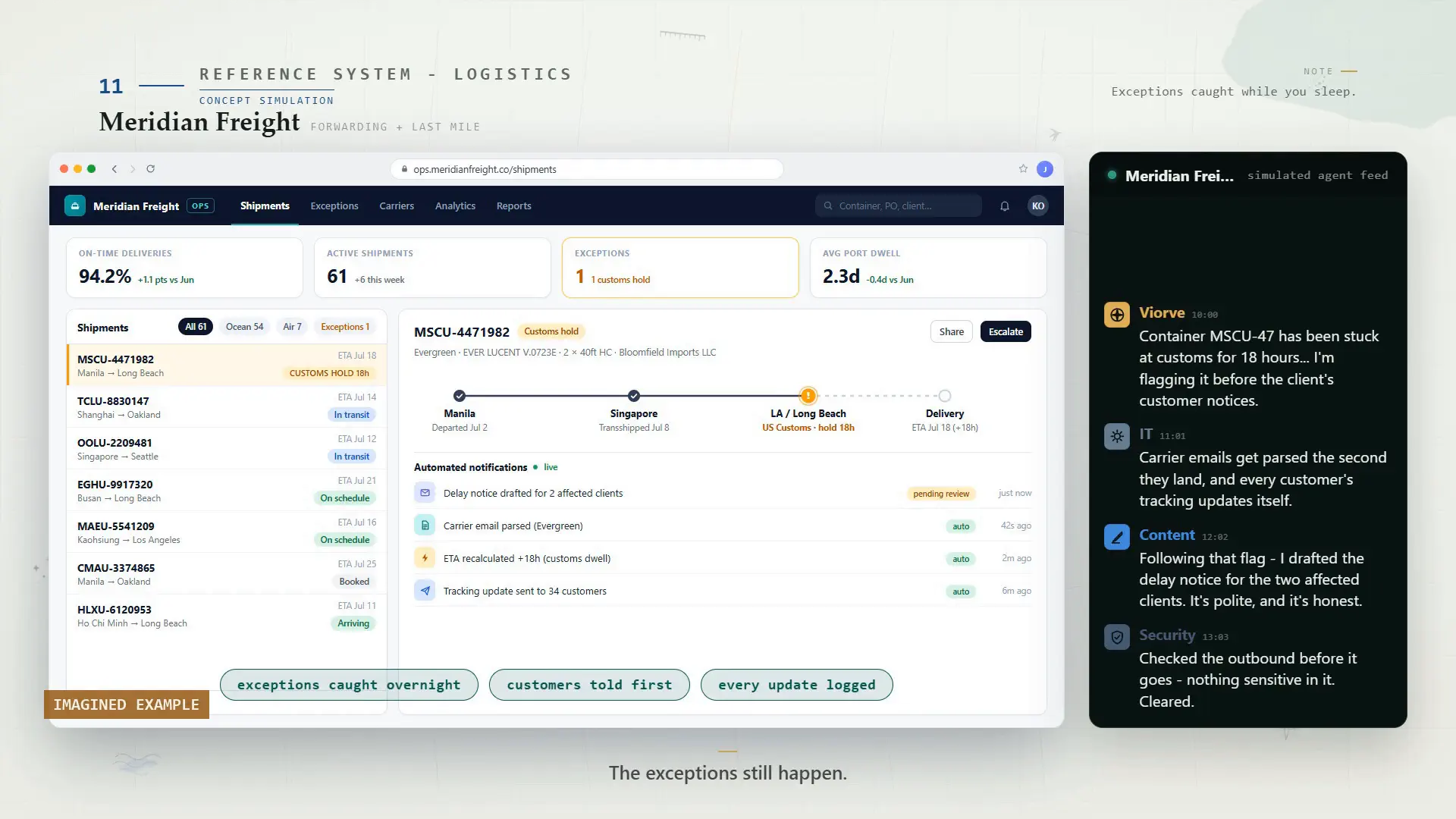
10Meridian Freight

Next one up. Say you move freight, and your whole day is exceptions — a truck's late, a lane got expensive, a customer wants an eta. The team watches all of it at once... and only pulls a human in when a call actually needs one.

The exceptions still happen. The owner just stops being the one who catches every one by hand.

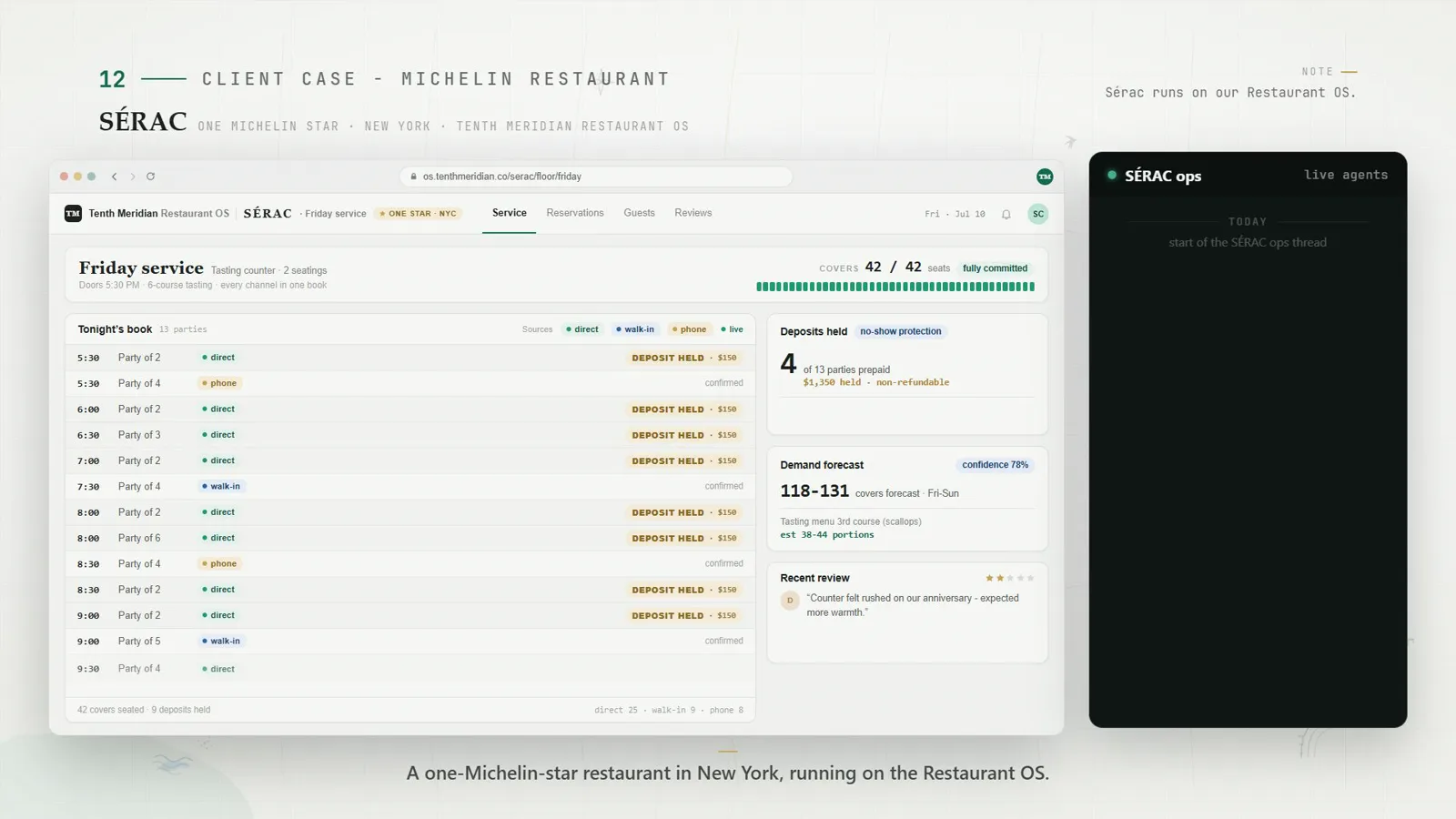
11SÉRAC

Now it gets good. A one-Michelin-star restaurant in New York, running on the Restaurant OS. Friday night, forty-two covers on the book, tasting menu... and mid-service, the system sees something coming.

Hey, what's good lookin?

Yeah, go for it. Good catch.

The scallops are about to run dry, with roughly forty minutes of service left. So the system doesn't just alert someone. It opens the neighbor network, calls four nearby restaurants, two come through with partials... and when the manager's still slammed, Viorve picks up the phone and calls the boss. The window to act was now... not at the walk-in.

A stockout that would have hit the pass... got caught, and solved, before the kitchen ever felt it.

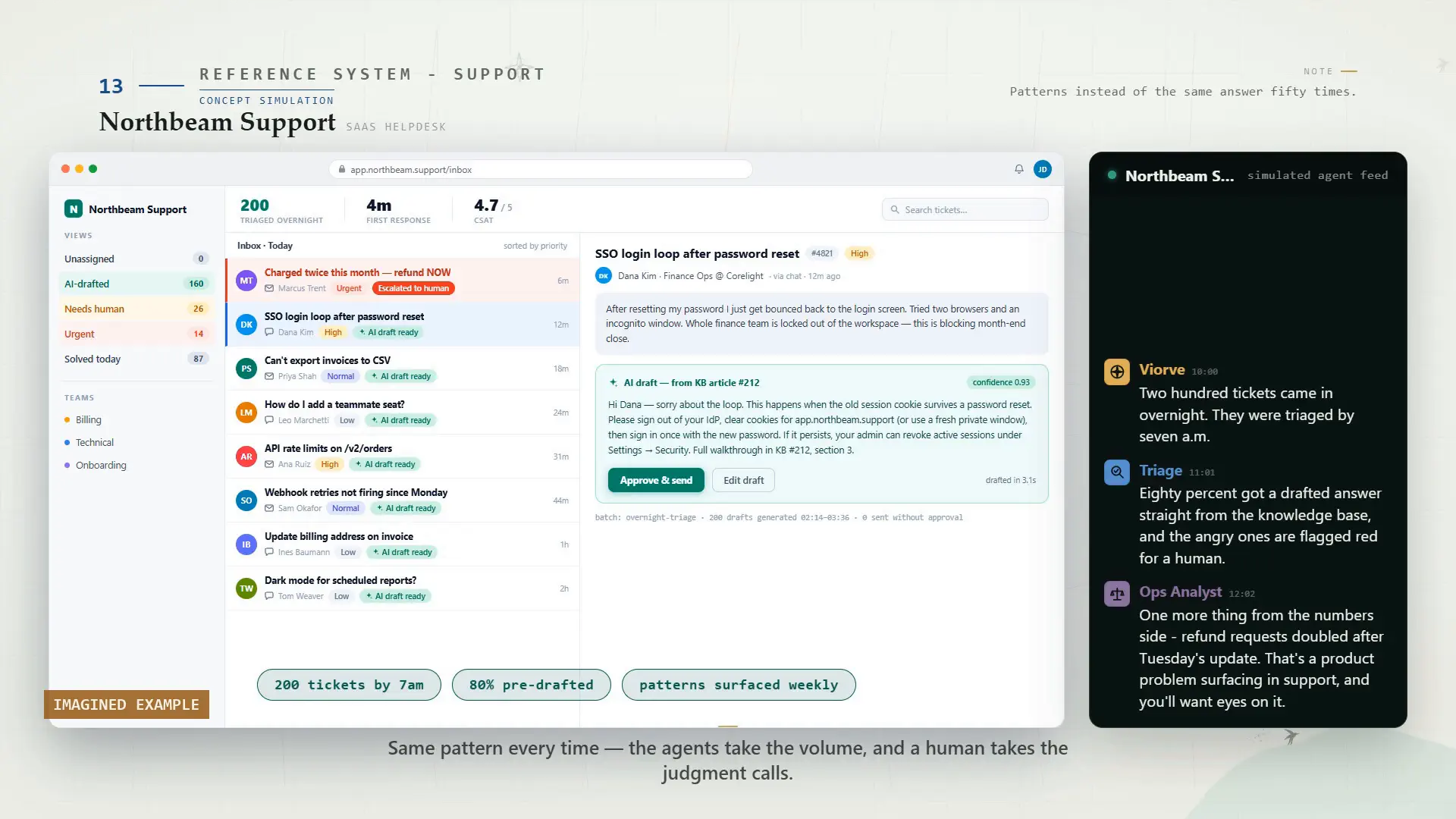
12Northbeam Support

Support desk. Every ticket read, sorted, and drafted the moment it lands — refunds, bugs, the angry ones flagged for a human first. The inbox stops being a pile... and starts being a queue that's already half-done.

Same pattern every time — the agents take the volume, and a human takes the judgment calls.

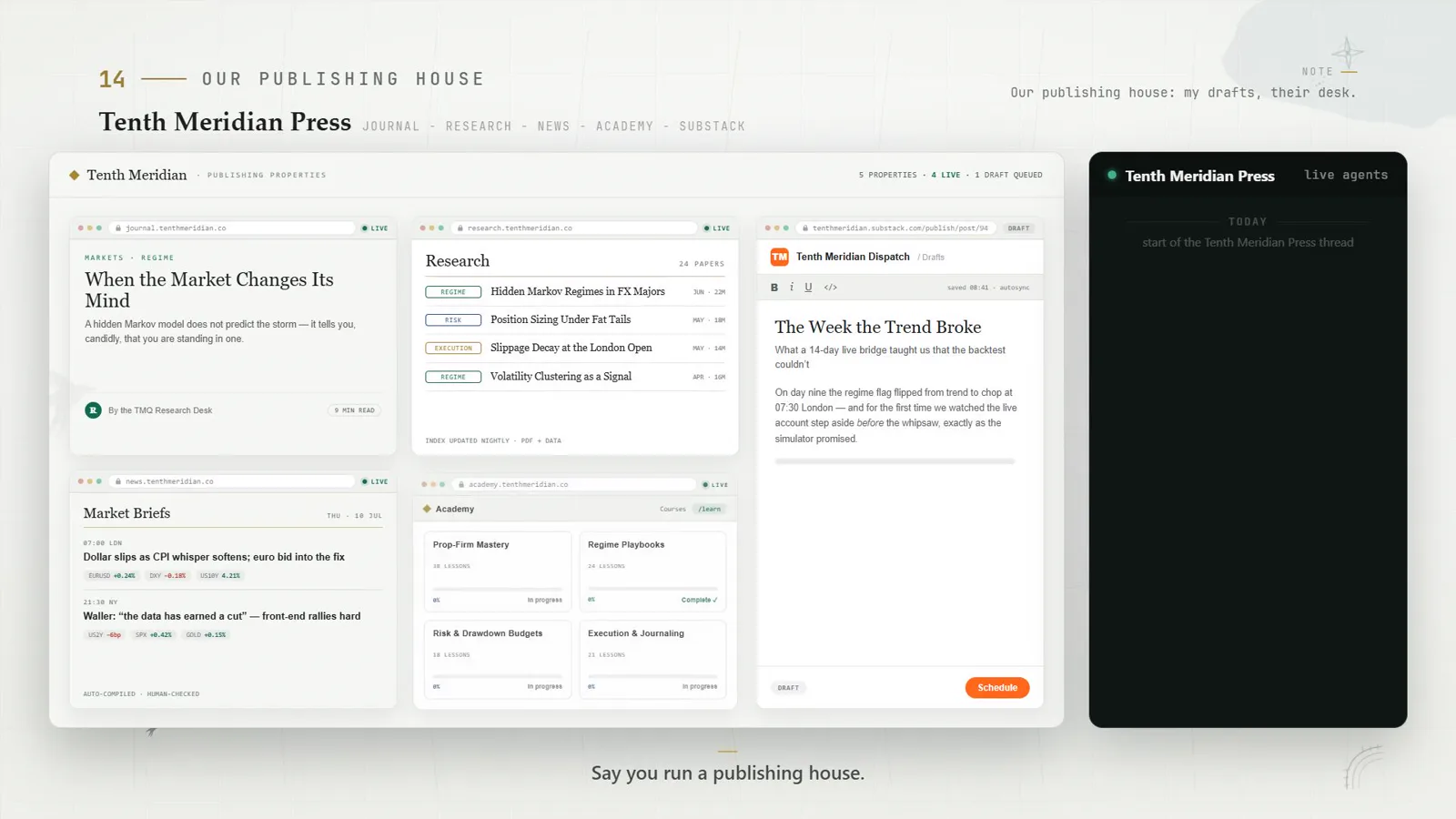
13Tenth Meridian Press

Say you run a publishing house. Drafts come in, and the agents read every one — line edits, fact-checks, house style, a clean summary for the editor. The writers stay writers... the desk around them just got a lot faster.

Nobody's voice gets replaced. The slow part just disappears.

14Quant validation

And here's the company's own book — the reason any of this exists. Proof before capital. Before a single dollar goes near a strategy, it has to prove itself: a five-year backtest on tick data, out of sample. Then validation — Monte Carlo, walk-forward, and the probability of overfitting has to sit under zero point three.

Then the red team tries to kill it. They double the slippage, shock the spreads, force regime flips... and if the edge only survives when the market is polite, it never ships. This one held... every single time.

15Client reporting

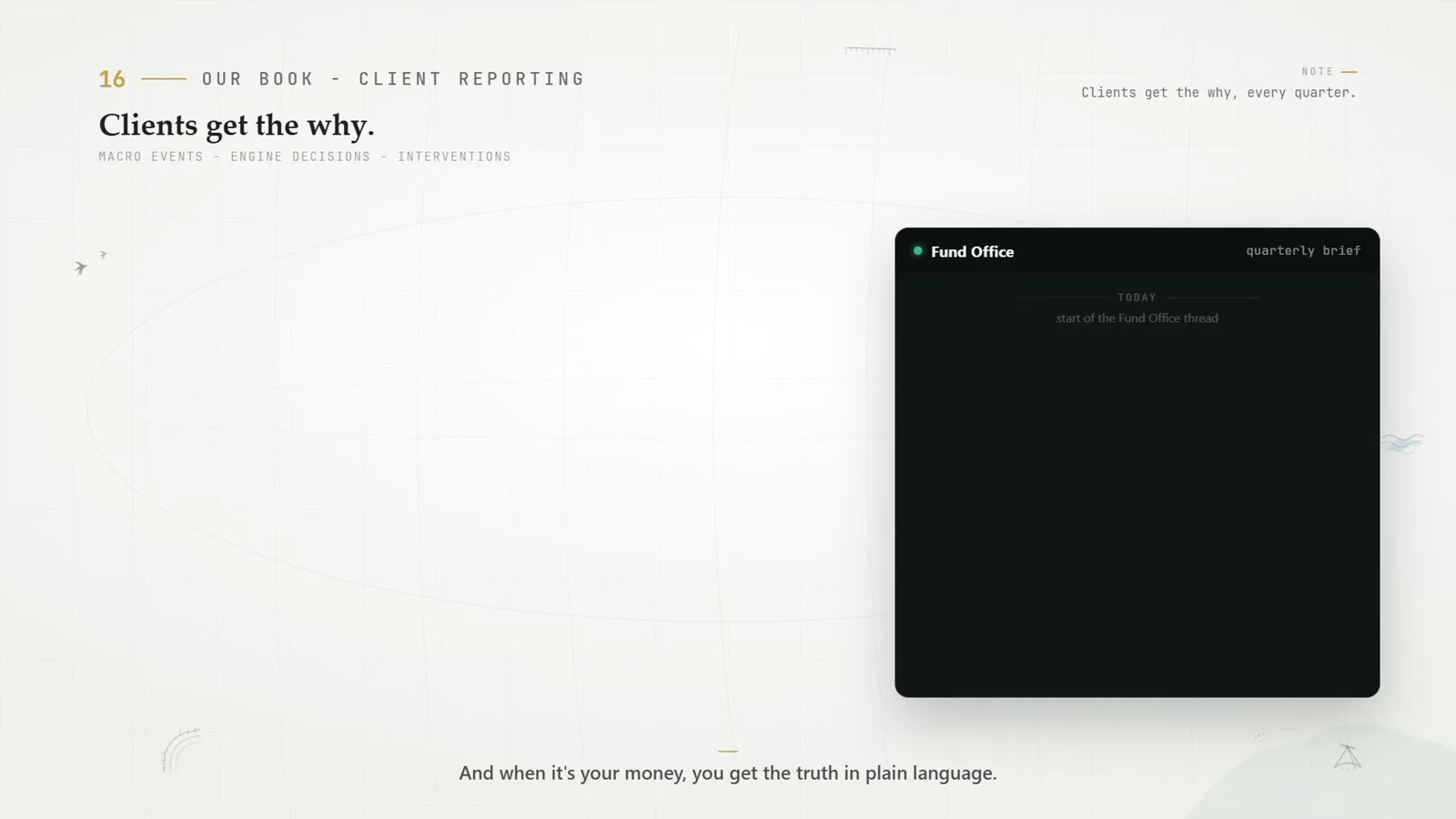
And when it's your money, you get the truth in plain language. Every quarter, the fund writes a real report — what it did, what it reasoned, where a human stepped in, and why. No jargon wall... just the receipts.

You always know what your money did. And you can always check the work.

16The cockpit

One last thing that's being built. The whole company as a room you can walk into — every agent at its desk, live. That 3D office is the next piece... coming soon. Today it already runs as the command room you've been watching.

17Pricing approach

So — the question everyone's waiting for. What this actually costs. The honest answer? It's priced by what your idea needs, not by the hour. Because a simple automation and a whole agent team... are not the same animal. Let me walk you up the ladder.

At the bottom, one automation, built and yours to keep. From about two thousand. One workflow that runs itself, hands the work back, and earns back the hours you were losing.

In the middle, a few automations wired together, with an agent that watches and reports. From about six thousand to build... and a small monthly to keep it sharp.

And at the top... a managed agent team. Built, and run, for you. A dedicated team for your business, working every day while you sleep — priced by conversation, because at that point you're not buying a project. You're keeping a team.

But whatever tier you're on, the real product is the same. A system that's still working a year from now... without anyone babysitting it.

18Tenth Meridian

So that's what he actually does now. Design the system, direct the agents, validate the result. Because the hard part was never the code. It was always knowing what the code should do. If you've got something worth building... Tenth Meridian is where it gets built.